
Practical Travel · 公開 2026-11-04 · 更新 2026-11-04
事実の最終確認 2026-11-04 · 次の見直し 2027-02-01
Your Japan trip, step by step: what to prepare and when
A timeline for a first trip to Japan: one month before, one week before, arrival day, airport to the city, every day of your stay and departure day, with the new tax-free refund. Checked on official pages.
この記事には広告(アフィリエイトリンク)を含みます。リンク先で予約すると当サイトが手数料を受け取ることがありますが、お客様の支払額は変わりません。 広告(アフィリエイト)について
Plan your first Japan trip in order: one month before, one week before, arrival, your stay and departure. Each step links to a longer guide on this site. The rules below come from the official pages listed under Sources; check the ones that apply to your own trip before you go.
Five things to check before you go
- Register on Visit Japan Web before you fly (immigration and customs, online)
- Buy travel medical insurance. The Ministry of Health strongly recommends it
- Carry your passport every time you go out (required for visitors aged 16 or over)
- Reserve a seat with oversized baggage space on the Tokaido, Sanyo and Kyushu Shinkansen if your bag is over 160 cm
- For tax-free purchases made on or after 1 November 2026, keep all the goods with you for customs confirmation before you leave Japan. The refund comes after that
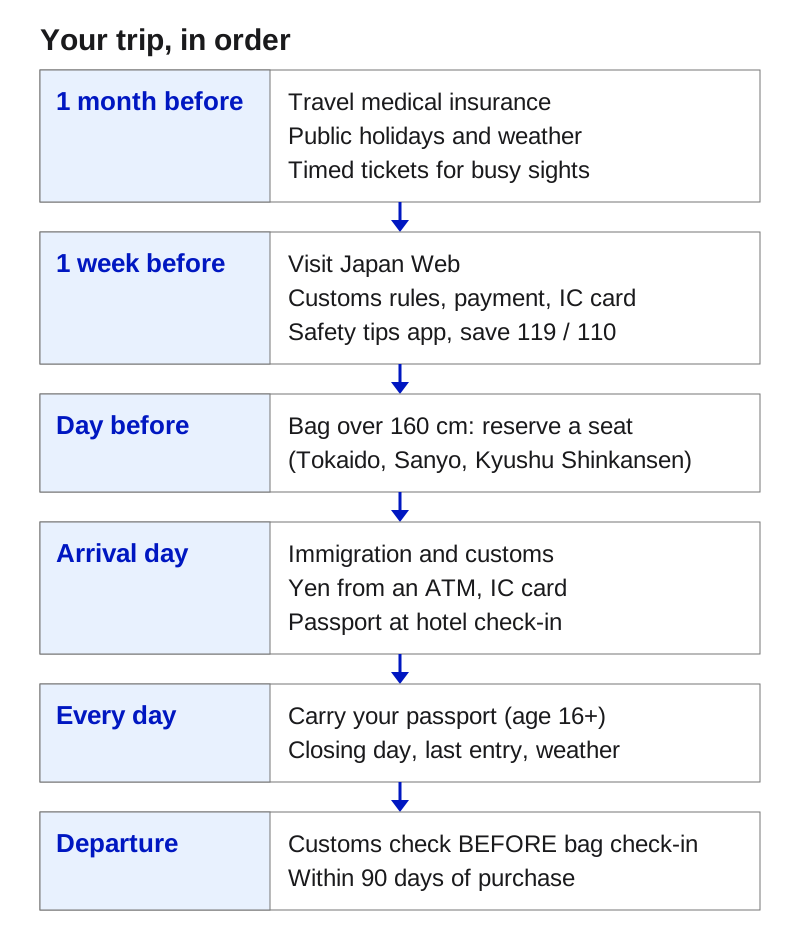
One month before
| What | Why it matters | Where to check |
|---|---|---|
| Buy travel medical insurance | Medical bills in Japan can be very costly. Unpaid medical bills may make future entry to Japan harder | Ministry of Health, Labour and Welfare |
| Check Japan's public holidays for your travel dates | To plan around them | Japan public holidays 2026-2027 |
| Check the weather for each destination before packing | To know what to pack | Japan weather by month |
| Check each attraction's booking rules | To book anything that needs it in advance | Avoid crowds with reservations |
Medical insurance. Japan's Ministry of Health, Labour and Welfare says that if you are injured or fall ill and need treatment in Japan, medical expenses can be very costly, and that failing to pay medical fees may result in stricter immigration procedures on future visits. It strongly recommends private health insurance with sufficient coverage. More on what happens if you get sick: Sick in Japan.
One week before
- Register on Visit Japan Web. The Digital Agency describes it as a service for doing arrival procedures (immigration and customs) and "Tax-free shopping service" online. It is also used for tax-free refunds at major airports (see Departure day below).
- Check what you cannot bring in. Japan Customs says plants and animals must go through quarantine inspection, and that medicine and cosmetics have quantity limits. For medicine, check your own medicine by ingredient and quantity in the Ministry of Health, Labour and Welfare's personal-import guide: the rules differ for prescription and other medicines, and some ingredients are prohibited or need advance permission. See Japan customs: allowances and banned items.
- Decide how you will pay. Check accepted payment methods at your accommodation and planned stops. See Is Japan still cash only?.
- Decide on a transport card. See IC cards for visitors.
- Install the Safety tips app (below).
- Save three phone numbers (below).
The Safety tips app. The Japan Tourism Agency's app sends earthquake early warnings, tsunami warnings and other weather warnings in Japan. It works in English, Japanese, Korean, Traditional Chinese, Simplified Chinese, Vietnamese, Spanish, Portuguese, Thai, Indonesian, Tagalog, Nepali, Khmer, Burmese and Mongolian. It also has an evacuation flowchart and phrases for asking people nearby for help. More: Earthquakes and typhoons.
Three numbers to save
| Number | When | Source |
|---|---|---|
| 119 | Fire, or someone seriously sick or injured (ambulance) | JNTO |
| 110 | Police: traffic accident, robbery, assault | JNTO |
| 050-3816-2787 | Japan Visitor Hotline (JNTO): 24 hours, 365 days, in English, Chinese and Korean. Help with illness, disasters and general travel questions | JNTO |
The day before: packing and big luggage
| Bag size (length + width + height) | Tokaido, Sanyo and Kyushu Shinkansen |
|---|---|
| Up to 160 cm | At your feet or on the rack above the seats. Some reserved-seat cars on Nozomi, Hikari and Kodama trains on the Tokaido and Sanyo Shinkansen also have a deck baggage storage area that needs no reservation |
| Over 160 cm, up to 250 cm | Reserve a seat with an oversized baggage space when you buy your ticket. Without a reservation, a fee of 1,000 yen (tax included) is charged |
| Over 250 cm | Not allowed on board |
Source: JR Central. This rule covers the Tokaido-Sanyo-Kyushu Shinkansen (Tokyo, Shin-Osaka, Hakata and Kagoshima-Chuo). If you plan to move hotels by train, sending your suitcase ahead is another option. See Luggage in Japan: Shinkansen, lockers and delivery.
Arrival day: airport to hotel
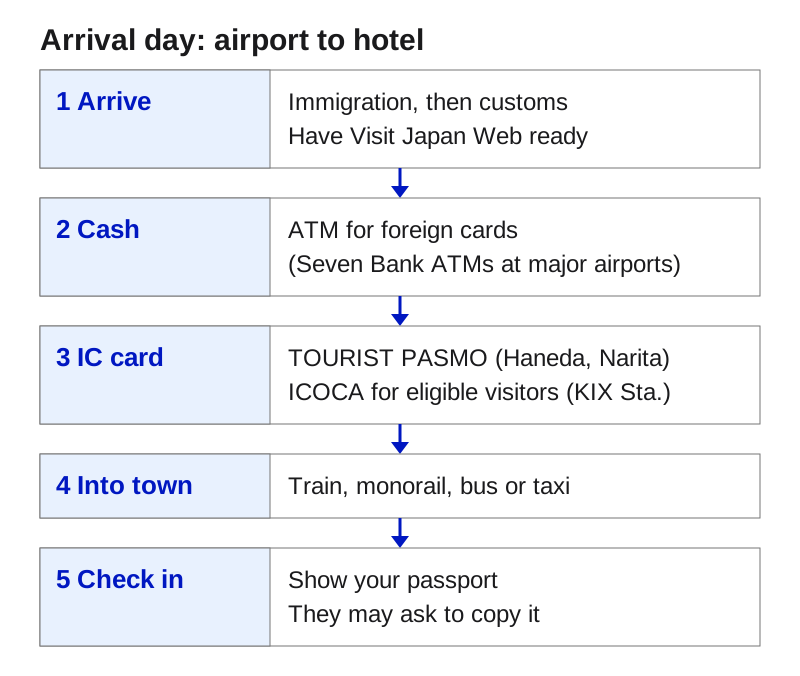
- Immigration and customs. If you registered on Visit Japan Web, have it ready.
- Get some yen. Seven Bank ATMs accept many foreign-issued cards, though some cards cannot be used. Seven Bank lists ATMs at New Chitose, Narita, Haneda, Chubu Centrair, Kansai, Fukuoka and Naha airports, and says there are over 28,000 of its ATMs at 7-Eleven stores across Japan. See Using a foreign card at Japanese ATMs.
- Get a transport card. At Haneda and Narita, TOURIST PASMO is sold by Keikyu (Haneda) and Keisei (Narita). PASMO says it needs no deposit and is valid for 28 days from purchase. Money left on it is not refunded, so top up in small amounts. See IC cards for visitors.
- Travel into the city. See the airport-by-airport sections below.
- Check in. Show your passport (next section). Check your booking or ask your accommodation whether an accommodation tax applies: Japan's accommodation tax.
Checking in: your passport. The Ministry of Health, Labour and Welfare says that by law, for guests from abroad who do not live in Japan, the guest register must include nationality and passport number, and that the government also asks hotels to see and copy the passport. Have it ready at the front desk.
Airport to the city: Narita, Haneda, Kansai and Sendai
Use the airport and railway pages linked below to plan your route. Fares and timetables change, so check current services before you travel.
Narita (Tokyo)
Narita Airport says rail access is by the Narita Sky Access line, the Keisei line and the JR line. Terminal 1 is a 5-minute walk from Narita Airport Station. Terminals 2 and 3 are a 5-minute and a 10-minute walk from Airport Terminal 2 Building Station.
| Train | Some of the major stations listed by Narita Airport |
|---|---|
| Skyliner (Keisei) | Nippori, Keisei Ueno |
| Access Express (Keisei) | Higashi-Matsudo, Nippori, Keisei Ueno |
| Keisei Main Line | Keisei Funabashi, Nippori, Keisei Ueno |
| Narita Express (JR) | Tokyo, Shinagawa, Shibuya, Shinjuku, Yokohama |
| JR Line | Chiba, Akihabara, Tokyo, Shinagawa, Shibuya, Shinjuku, Ikebukuro |
These are selected stations from the airport's access page, not a promise that one train serves every station. Check the destination and any change of trains before boarding. Narita Airport also notes that some Skyliner trains stop at Aoto and Shin-Kamagaya. TOURIST PASMO is sold at Narita by Keisei (see Arrival day above).
Haneda (Tokyo)
Haneda Airport is directly connected to the Keikyu Line and the Tokyo Monorail. Haneda's own estimates of travel time:
| To | About |
|---|---|
| Shinagawa | 15 minutes |
| Hamamatsucho | 20 minutes |
| Tokyo | 30 minutes |
| Yokohama | 30 minutes |
| Ueno / Asakusa | 40 minutes |
| Shibuya | 45 minutes |
| Shinjuku | 50 minutes |
At Terminal 3 (international), the Keikyu ticket gates for central Tokyo and Yokohama are in the arrival lobby on the 2nd floor. The Tokyo Monorail gates are on the 2nd floor arrival lobby and the 3rd floor departure lobby. Haneda's taxi area has two kinds of stands: general stands, and separate stands for taxis booked by app or phone. For taxi fares in Tokyo, see Tokyo taxi fares.
Kansai (Osaka and Kyoto)
Choose your train by the station nearest your hotel. JR West's HARUKA runs directly from Kansai-airport Station to Tennoji, Osaka, Shin-Osaka and Kyoto. The Kansai-Airport Rapid Service is another JR option for Osaka and Tennoji. For Namba, Nankai runs the Limited Express Rapi:t and the Airport Express. Rapi:t needs an extra limited express ticket; the Airport Express needs only a normal ticket. Check the railway's current timetable before you travel.
Eligible foreign Temporary Visitors can buy JR West's original-design ICOCA at the JR ticket office in Kansai-airport Station. See IC cards for visitors.
Sendai (Tohoku)
The Sendai Airport Access Line runs from Sendai Airport to JR Sendai Station in about 25 minutes without changing trains, according to Sendai Airport Transit. It runs about 2 or 3 times an hour.
Every day of your stay
- Carry your passport. Foreign visitors aged 16 or over staying as Temporary Visitors must carry their passport and show it if the police ask (Tokyo Metropolitan Police Department; the requirement does not apply to children under 16 under the Immigration Control Act). See Passport rules in Japan.
- Check the closing day and last entry before you go: check both the closing time and the last admission time on the attraction's official website. See Opening-hours traps and Which day are sights closed?.
- Check the weather and warnings. Check weather warnings and your destination's official notices before setting out. See Weather closures.
- In summer, check the heat stroke alert. See Heat stroke alerts.
- Know the basic manners for trains, food, onsen and temples. See Japan travel etiquette.
When something goes wrong
| What happened | First thing to do | More |
|---|---|---|
| You lost something | See where to ask, and in what order | Lost property in Japan |
| You feel ill | Call the Japan Visitor Hotline (050-3816-2787) for help finding a clinic. In an emergency, call 119 | Sick in Japan |
| An earthquake or typhoon | Follow the Safety tips app and staff instructions | Earthquakes and typhoons |
| A stranger pulls you into a bar | Do not follow street touts | Touts and bar scams |
To have someone call an ambulance for you, JNTO suggests showing this sentence to a person nearby:
救急車を呼んでください。 (Please call an ambulance.)
Departure day: tax-free refunds have changed
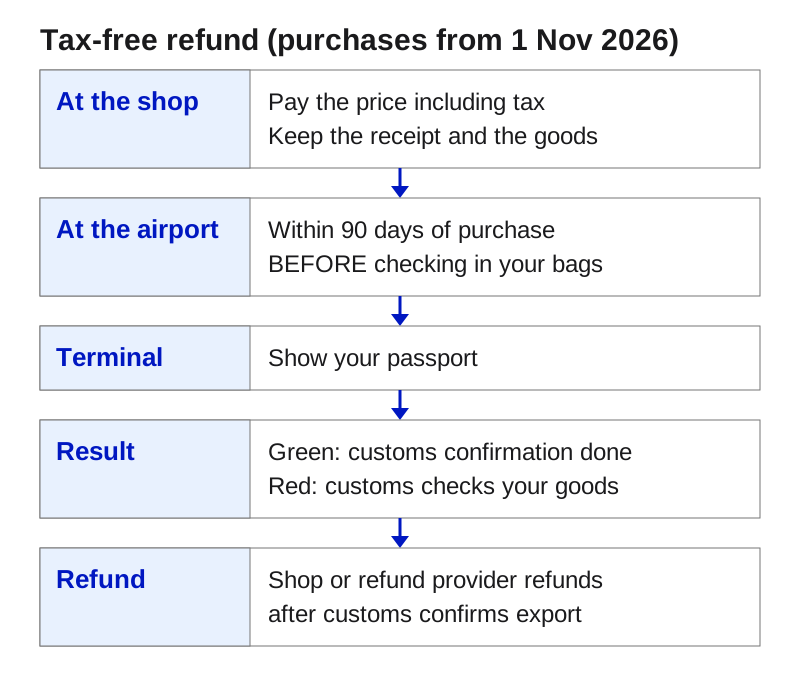
For eligible purchases made on or after 1 November 2026, Japan's tax-free shopping uses a refund method. According to the Japan Tourism Agency:
- You pay the price including consumption tax at the shop.
- Within 90 days of the purchase, at the airport or seaport when you leave, you show your passport at a tax-free procedure terminal.
- The screen shows green (customs confirmation complete) or red (customs checks your goods at the inspection area).
- After customs confirms the goods are leaving Japan, the shop or its refund provider refunds the tax. How and when depends on the shop, so ask when you buy.
Things to know:
- Do it before you check in your bags. You must have all the tax-free goods with you. Once a bag is checked in, you cannot get it back for the tax-free procedure.
- Leave time. The procedure, and any inspection, must be finished before boarding. If you miss your flight because of it, neither the airline nor customs compensates you.
- One receipt, all items. Customs confirms each purchase (receipt). If one item from a receipt is missing, you get no refund for anything on that receipt.
- Ate it already? If you consumed tax-free goods before leaving, tell a customs officer at the counter instead of using the terminal.
- At big airports (Narita, Haneda, Kansai, Chubu, Fukuoka, New Chitose and Naha) you can also do it on Visit Japan Web, on the dedicated Wi-Fi in the international departure lobby (up to security). This is only for "Temporary Visitor", "Diplomat" or "Official" status.
- Flying home via a domestic flight? Do the procedure at the last airport before you leave Japan.
More: Tax-free shopping and the refund method.
A one-page checklist to save
One month before: insurance / holidays / weather / timed tickets
One week before: Visit Japan Web / customs rules / cash and cards / transport card / Safety tips app / 119, 110, 050-3816-2787
The day before: bag size (over 160 cm and up to 250 cm = reserve a baggage-space seat on the Tokaido, Sanyo or Kyushu Shinkansen) / clothes for the forecast
Arrival day: immigration and customs / yen from an ATM that takes your card / IC card / passport at check-in
Every day: passport with you / closing day and last entry / weather / heat
Departure day: tax-free goods in hand, customs confirmation before bag check-in and within 90 days of purchase / leave time
Sources
- Digital Agency, "Visit Japan Web": https://www.digital.go.jp/en/policies/visit_japan_web (checked 2026-11-04)
- Ministry of Health, Labour and Welfare, "We strongly recommend enrolling in private health insurance": https://www.mhlw.go.jp/stf/newpage_46516.html (checked 2026-11-04)
- Ministry of Health, Labour and Welfare, notice on passport presentation and copies for foreign guests (in Japanese, with foreign-language versions): https://www.mhlw.go.jp/stf/seisakunitsuite/bunya/0000130600_00001.html (checked 2026-11-04)
- Tokyo Metropolitan Police Department, "Do I always have to carry my passport or residence card with me?": https://www.keishicho.metro.tokyo.lg.jp/multilingual/english/finding_services/living_guide/living_guide_e_4.html (checked 2026-11-04)
- JNTO, "Guide for when you are feeling ill" (119, 110, Japan Visitor Hotline): https://www.jnto.go.jp/emergency/eng/mi_guide.html (checked 2026-11-04)
- Japan Tourism Agency, "Safety tips" app: https://www.jnto.go.jp/safety-tips/eng/app.html (checked 2026-11-04)
- JR Central, "Luggage information": https://global.jr-central.co.jp/en/info/oversized-baggage/ (checked 2026-11-04)
- Narita International Airport, "Rail": https://www.narita-airport.jp/en/access/train/ (checked 2026-11-04)
- Haneda Airport Passenger Terminal, "Train & Monorail": https://tokyo-haneda.com/en/access/train/index.html (checked 2026-11-04)
- Haneda Airport Passenger Terminal, "Access" (taxi stands): https://tokyo-haneda.com/en/access/index.html (checked 2026-11-04)
- JR West, "ICOCA - How to use JR-West": https://www.westjr.co.jp/global/en/howto/icoca/ (checked 2026-11-04)
- Sendai Airport Transit, "Sendai Airport Access Line": https://www.senat.co.jp/en/top (checked 2026-11-04)
- Seven Bank, ATMs for foreign-issued cards: https://www.sevenbank.co.jp/intlcard/index2.html (checked 2026-11-04)
- PASMO, "TOURIST PASMO": https://www.pasmo.co.jp/en/tourist-pasmo/ (checked 2026-11-04)
- Japan Customs, "Procedures of Passenger Clearance": https://www.customs.go.jp/english/summary/passenger.htm (checked 2026-11-04)
- Ministry of Health, Labour and Welfare, personal import of medicines (Drugs, Quasi drugs): https://www.mhlw.go.jp/stf/seisakunitsuite/bunya/kenkou_iryou/iyakuhin/kojinyunyu/topics/tp010401-1_00001.html (checked 2026-11-04)
- Immigration Control and Refugee Recognition Act, Article 23 (e-Gov, in Japanese): https://laws.e-gov.go.jp/law/326CO0000000319/20250919_507AC0000000075 (checked 2026-11-04)
- JR West, "HARUKA One-way Ticket": https://www.westjr.co.jp/travel-information/en/tickets-passes/oneway/haruka/ (checked 2026-11-04)
- JR West, train usage guide from Kansai Airport: https://www.westjr.co.jp/travel-information/en/train-usage-guide/howto/guide/ (checked 2026-11-04)
- Nankai Electric Railway, "Timetable / Train Services": https://www.nankai.co.jp/en_railway/access-timetable (checked 2026-11-04)
- Japan Tourism Agency, "Regarding Refunds": https://www.mlit.go.jp/kankocho/tax-free/page01_000001_00056.html (checked 2026-11-04)
- Japan Tourism Agency, tax-free shopping, "Special page for travelers": https://www.mlit.go.jp/kankocho/tax-free/page01_000001_00028.html (checked 2026-11-04)